
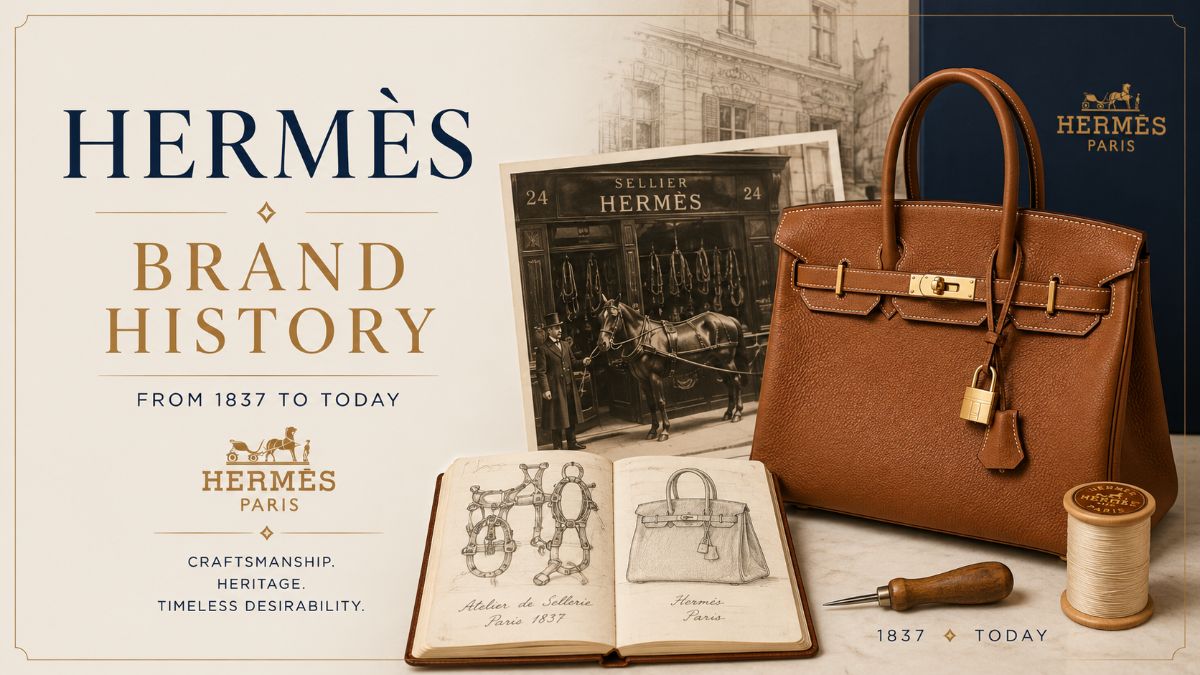
It all began in 1837 in a harness workshop on Rue Basse-du-Rempart, Paris. The same family still runs the business today. The same hand-stitching technique still produces the bags. A Birkin that retailed for roughly $2,000 in 1984 can now sell at auction for hundreds of thousands.
None of that happened by accident.
Source an Authenticated Hermès Bag Through WeCarryBags
Hermès History Timeline
1837.
Thierry Hermès sets up on Rue Basse-du-Rempart in Paris. Harnesses for cavalry officers and carriage owners. Built to last, finished properly. That's the whole brief.
1855 and 1867.
Two first-class medals, twelve years apart. The 1867 one at the Exposition Universelle opens doors to Tsar Nicholas II, Napoleon III, Empress Eugénie. The workshop's reputation goes international.
1880.
Charles-Émile moves to 24 Faubourg Saint-Honoré. Retail for the first time. Clients from across Europe, Russia, North Africa, the Americas, Asia. The address doesn't change again.
1902.
The company becomes Hermès Frères. The Haut à Courroies bag is introduced, originally designed to carry riding saddles and boots. Hermès's first structured bag, and a direct ancestor of the Birkin.
1922.
Émile-Maurice secures the exclusive French rights to the zip fastener, applying it to Hermès leather goods before it appeared almost anywhere else in luxury fashion. The first publicly marketed women's handbag line launches the same year.
1925 to 1928.
A men's golf jacket in 1925, the first ready-to-wear piece. Jewellery in 1927. Watches and sandals in 1928. Each category added without departing from the craft logic that underpins everything else.
1937.
Robert Dumas creates the first Hermès silk scarf, Jeu des omnibus et dames blanches, using Lyon silk and a bold printed design unlike anything available in fashion at the time. Over 3,000 unique scarf designs have followed.
1956.
A photograph of Grace Kelly of Monaco using her Hermès Sac à Dépêches to shield herself from photographers appears in Life magazine. Women begin asking for the bag by her name. It is formally renamed the Kelly in 1977.
1978.
Jean-Louis Dumas takes the chair. Sales roughly US$50 million. He puts watchmaking on the books under La Montre Hermès, takes the brand global, and does what no one in the family had done before: brings in designers from outside.
1984.
Birkin launches. Jean-Louis Dumas and Jane Birkin, Paris-to-London flight, early 1980s. She needed a bag that worked for daily life. They sketched one on an air sickness bag. Black leather, double handles, lock and clochette, saddle stitch. That's the first one.
1993 to 1995.
Puiforcat silversmiths in 1993. Saint-Louis crystalworks in 1995. Specialist makers that couldn't survive alone. Hermès absorbs them rather than watching the skills go.
2010.
Petit h launches, made entirely from leftover and flawed Hermès materials reworked into one-off objects. The house producing luxury goods from its own offcuts. No waste, no outsourcing.
2011.
H51, the family holding company, is formed by 52 Hermès family shareholders holding more than 50% of the company's capital. Created specifically to resist LVMH's hostile accumulation of shares. By 2017, Bernard Arnault has sold his remaining stake.
2013.
Axel Dumas, sixth generation, appointed managing director. Patrick Thomas, the only non-family CEO in the house's history, steps down.
2020.
Beauty division launches, the sixteenth business line and the most recent major category expansion.
April 2025.
Hermès tops LVMH briefly as the world's most valuable luxury company, over €243 billion. Started as a harness workshop on a street that no longer exists.
How Hermès Expanded Beyond Saddlery
The shift away from equestrian goods wasn't a departure from the house's identity. It was an extension of it.
Leather goods came first, the same materials and stitching techniques applied to luggage and travel accessories as the horse-and-carriage era gave way to trains and automobiles. The zip, a genuine innovation when Émile-Maurice adopted it in the 1920s, appeared on Hermès bags before it appeared almost anywhere else in fashion.
The silk scarf followed in 1937, introduced by Robert Dumas. Each design was a collaboration with an outside artist, hand-finished and produced at the house's own silk facility in Lyon.
Sixteen business lines now. Watches, jewellery, ready-to-wear, homeware, beauty. Each one added only when the house was satisfied it could actually meet its own standards there.
The Stories Behind the Kelly and Birkin Bags
The Kelly predates the Birkin by decades. Originally called the Sac à Dépêches, it was designed in the early 1930s as a structured document bag. Its transformation into an icon happened in 1956, when a photograph of Grace Kelly using one to shield herself from photographers appeared in Life magazine. Formally renamed the Kelly in 1977.
The Birkin's origin is less formal. Jane Birkin was on a flight in the early 1980s, ended up next to Jean-Louis Dumas, complained she couldn't find a bag that actually fit her life. They drew something out together. It went into production and launched in 1984.
Each bag, Birkin or Kelly, gets made by one person. Start to finish. Signed. Fifteen to twenty hours. The stitch is two needles, two waxed linen threads, pulled against each other. Thierry Hermès was doing exactly this in the 1840s.
Why Hermès History Matters Before Buying
Understanding the Hermès brand history is practically useful when you're sourcing a piece.
Production era affects value. Hardware changes over decades can help date a bag precisely. Leather type, stamp markings, and construction details all reflect where a piece sits in the house's history. A bag from the early Birkin years carries different collector significance to a contemporary piece, even within the same model.
Authentication matters because the history of Hermès has generated a secondary market worth significant sums, and that market attracts convincing counterfeits. OurHermès authentication guide andguide to spotting a real Birkin go through what matters by era, hardware, and leather.
WeCarryBags sources authenticated Hermès pieces through trusted networks, checked before anything ships.
Enquire About Authenticated Hermès Availability
Frequently Asked Questions
Who founded Hermès?
Thierry Hermès, born Krefeld 1801. Trained in Normandy, opened a harness workshop in Paris in 1837. Served the European nobility and French imperial household.
When was Hermès founded?
In 1837 in a workshop at 56 Rue Basse-du-Rempart, Paris. Charles-Émile moved to 24 Faubourg Saint-Honoré in 1880, still the address.
Why is Hermès so expensive?
Hermès uses a single artisan per bag. Around eighteen months of training before touching a Birkin or Kelly. Same hand stitch since the 1840s. Premium leather, limited output. The cost follows directly from how it's made.
What is the history of the Birkin bag?
Early 1980s flight, Paris to London. Jane Birkin next to Jean-Louis Dumas. She needed a bigger bag, they designed one on an airsickness bag. Launched 1984, black leather.
What is the history of the Kelly bag?
Started as the Sac à Dépêches in the early 1930s, used for documents. Grace Kelly was photographed with one in 1956, image ran in Life magazine, demand followed. Formally renamed Kelly in 1977.
Before You Buy Hermès
Production year, hardware stamp, leather type. All of it feeds into what an authenticated Hermès piece is actually worth. The history isn't background. It's the reference point for every buying decision.
Got a specific piece in mind? WeCarryBags handles sourcing, authentication, and delivery.
Enquire About Authenticated Hermès Availability
Get Started with WeCarryBags
Hassle-free experience delivers your Shopping bags from Store to Door.


We are endorsed by

Contact
Carrybags Limited
111 New Union Street,
CV1 2NT, Coventry,
United Kingdom

Copyright © 2026, All rights reserved.